I'm Suhas Anumolu, a dedicated student researcher passionate about advancing cybersecurity through AI. This portfolio captures my journey developing models, analyzing data, and tackling real-world challenges to protect networks and data from malicious actors.
Feel free to explore my detailed research papers, project showcases, and technical insights shared throughout this site.

This portfolio highlights my work at the intersection of artificial intelligence and cybersecurity. I focus on designing, implementing, and evaluating machine learning models that enhance the detection and prevention of cyber attacks across diverse network environments.
My research spans multiple methodologies, including deep learning architectures, classical machine learning techniques, and unsupervised anomaly detection. Beyond model development, I emphasize interpretability and practical deployment challenges to ensure solutions can be trusted and integrated effectively.
View ProjectsApplying CNNs and LSTMs to model complex spatial and temporal patterns in network traffic, enabling the detection of sophisticated attacks like DDoS, data exfiltration, and zero-day exploits.
Using Random Forests, Gradient Boosting, and ensemble techniques to balance interpretability and performance in cybersecurity classification tasks.
Exploring autoencoders, clustering, and statistical models to identify novel and stealthy threats without relying solely on labeled data.
Utilizing multiple datasets, including CICIDS2017, UNSW-NB15, and custom-collected network data to ensure robust model validation and real-world applicability.
My research process integrates data preprocessing, feature engineering, model design, and rigorous evaluation. I leverage cross-validation and hyperparameter tuning to optimize model performance. Interpretability techniques, such as SHAP values and feature importance, are applied to understand decision drivers and build trust in AI predictions.
In addition to theoretical development, I conduct real-world simulations and prototype deployments to assess scalability, latency, and integration with existing cybersecurity infrastructures.
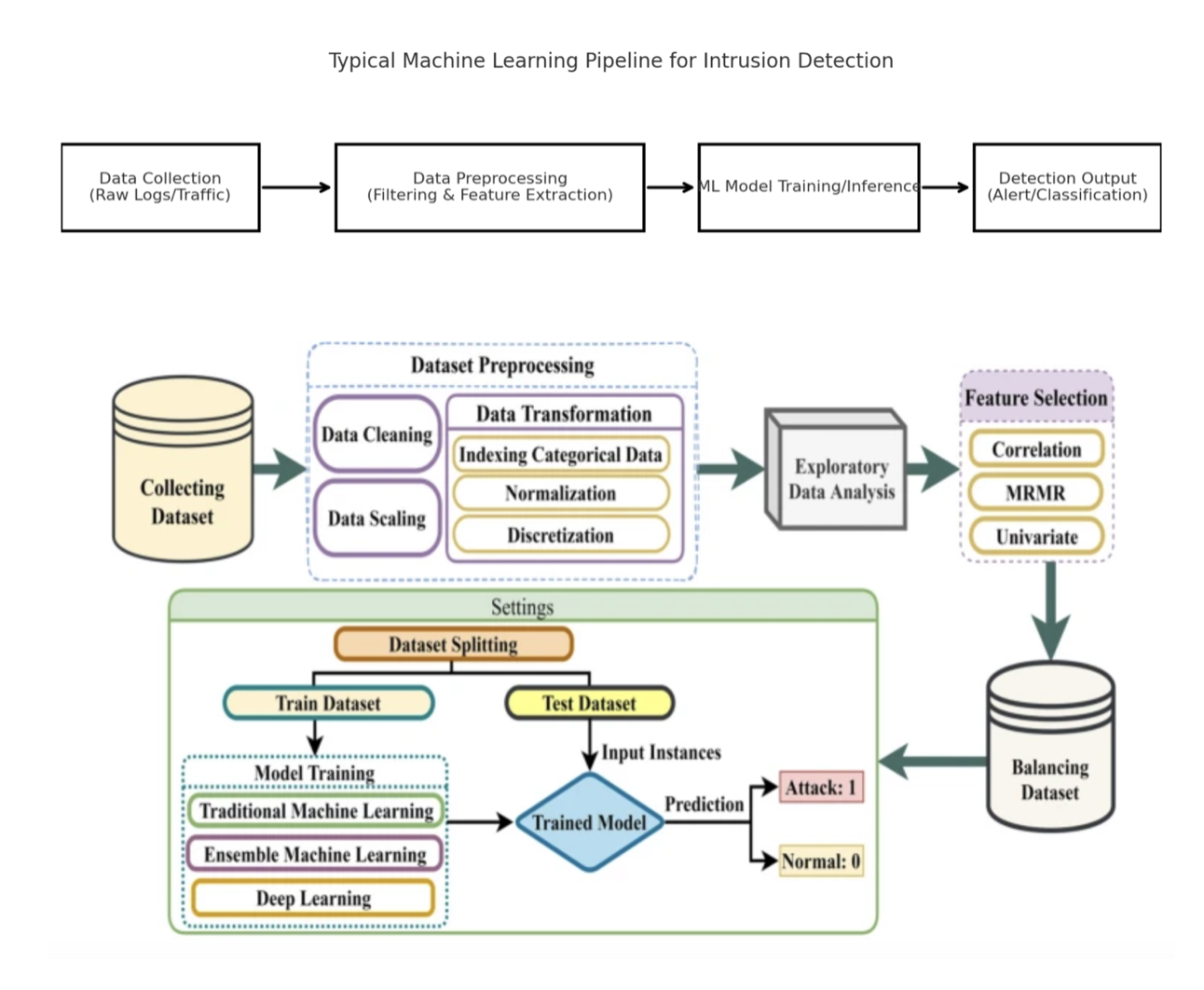
This diagram outlines the end-to-end machine learning pipeline used in my intrusion detection system. It begins with raw network traffic, which is processed into structured features through preprocessing and transformation.
Feature engineering techniques such as one-hot encoding, normalization, and statistical extraction are applied to optimize input for various models. The data is then split for training and validation, where algorithms like CNNs, LSTMs, and Random Forests are applied. Evaluation metrics like precision, recall, and F1-score guide performance improvements.
The final step involves deployment simulations and real-world validation to assess the system's capability in live environments. Explainability tools such as SHAP enhance transparency and trust in model predictions.
The ultimate goal of my research is to create cybersecurity tools that are accurate, reliable, and practical for deployment in dynamic environments. By reducing false positives and improving detection speed, these models can support security teams in responding more effectively to emerging threats.
Future work will focus on expanding multi-modal data integration, enhancing real-time threat intelligence, and developing explainable AI frameworks tailored for cybersecurity analysts.